
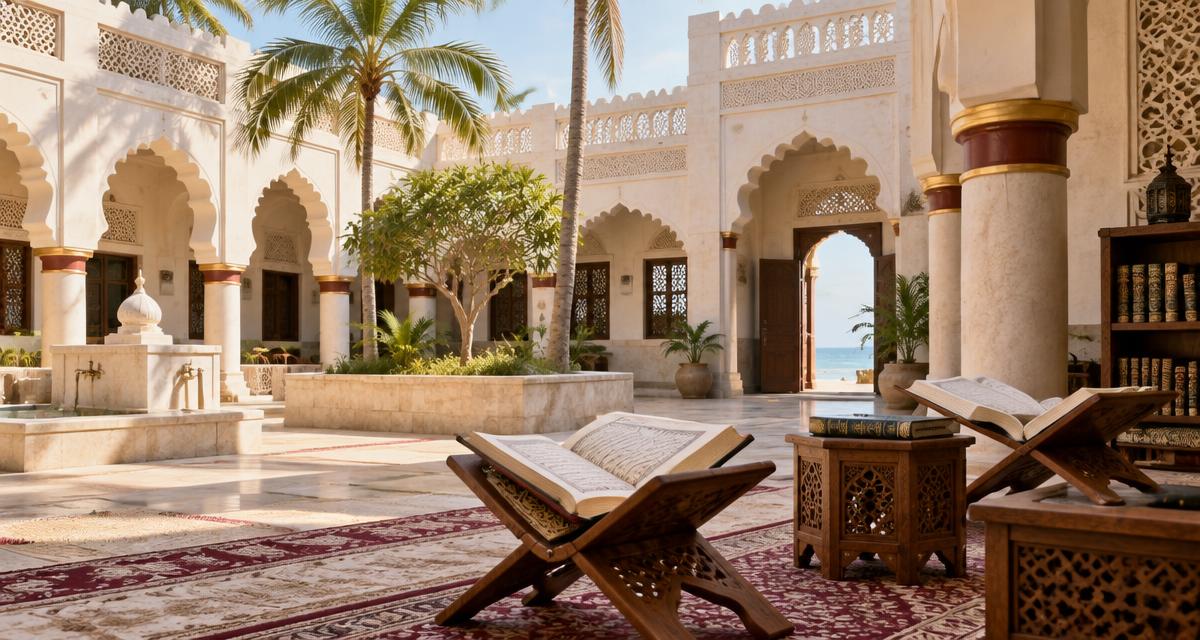
Established on the Swahili coast
A Madrassah of calmscholarship, for thechildren of Mombasa.
Qur'an, Hifz, Tajweed and the Islamic sciences taught with patience and rigour — from the first Arabic letters in Raudha to classical texts in Thanawy.
- 300+
- Students enrolled
- 19
- Classes
- 4
- Levels of study
About the institution
Founded to keep the Qur'an at the centre of a coastal childhood.
Dar Al Naeem began as a small evening halaqa for a handful of families in Mombasa who wanted their children to read the Qur'an properly before they read anything else. It grew, as these things do, because parents told other parents.
Today it is a structured Madrassah of more than three hundred students across nineteen classes, led by a teaching body of Ustadhs and Ustadhas drawn largely from the coast itself. The ladder from Raudha to Thanawy is deliberately unhurried: a child who leaves us should recite with correct makharij, understand what they recite, and carry adab that outlasts any examination.
We hold two terms a year, sit outside of school hours so that secular schooling is never compromised, and keep class sizes small enough that every child is heard reciting each week.
Dr. Islam Muhammad Salim
Director
Leadership
Dr. Islam Muhammad Salim — Director
Dr. Islam Muhammad Salim is a Kenyan Islamic scholar and academic. He holds a Bachelor's degree in Islamic Law from the University of Imam Muhammad Bin Saud, a Master's in Management from the International Islamic University Malaysia (IIUM), and a PhD in Islamic Finance, also from IIUM. He founded Dar Al Naeem on a simple conviction: that Islamic education in Mombasa deserved the same seriousness of record-keeping, assessment and accountability as any institution of standing.
He brings over fourteen years of academic administration and teaching across public and private higher education, including Jomo Kenyatta University of Agriculture and Technology (JKUAT), the Technical University of Mombasa, Pwani University and the Gulf African Bank Foundation, alongside international experience with the Saudi Ministry of Higher Education, Munawwarah College and RAF University. He currently also chairs the Shariah Advisory Board at SIB Najah, and still teaches the senior Mutawasit Aqeedah circle himself on weekends.
"A Madrassah is measured not by how many children pass through it, but by how many carry the Qur'an out of it — and keep it."
The ladder
Raudha to Thanawy — four levels, taught in order.
A child ordinarily spends two to three years at each stage. Progression is by assessment, never by age alone.
- 01
Raudha
Ages 5 – 8
Nursery. Arabic letters, short surahs by listening, prayer habits and adab, then fluent reading of the Mushaf and the first steps of Tajweed and Hifz.
- 02
Ibtida'e
Ages 9 – 12
Primary. Six classes covering Fiqh of worship, Aqeedah, Seerah and Arabic grammar alongside daily Hifz.
- 03
Mutawassit
Ages 13 – 15
Intermediate. Textual study, memorisation consolidation, and Arabic language capable of reading classical works.
- 04
Thanawy
Ages 16 +
Secondary. Classical texts in Aqeedah, Fiqh, Tafsir and Arabic, Hifz completion, and preparation to teach others.
Qur'an & Hifz
Daily sabaq and murajaah, tracked juz by juz.
Tajweed
Makharij and rules assessed formally every term.
Fiqh, Aqeedah, Seerah, Arabic, Akhlaq
Written termly examinations with teacher remarks.
Gallery
Life at Dar Al Naeem.
When we sit
Outside school hours, never in competition with it.
The academic year runs in two terms. Attendance is marked class by class at every session and reviewed by the Director each week.
Monday – Thursday
4:00 pm – 6:00 pm
Weekday evening sessions
Saturday & Sunday
7:00 am – 12:30 pm
Extended weekend sessions
Term 1
January – April
Followed by term assessments
Term 2
July – October
Followed by term assessments
Admissions
Send an inquiry and the registrar will call you.
Admissions open before each term. Children from age five are placed into Raudha; older children sit a short reading assessment so we place them at the right level.